
There are some things that simply take time.
A family farm passed from one generation to the next. An apple orchard planted by a grandfather and still welcoming families more than a century later. A frozen treat that began as a regional favorite and became an American icon. Grapevines planted as an experiment that grew into a family legacy. A downtown brewery or winery creating new traditions for today’s generation.
This October, Marion Grows: Food & Farms explores the many ways agriculture continues to shape Marion County—and the people, businesses, and traditions that have grown from it.
A Legacy Rooted in the Land
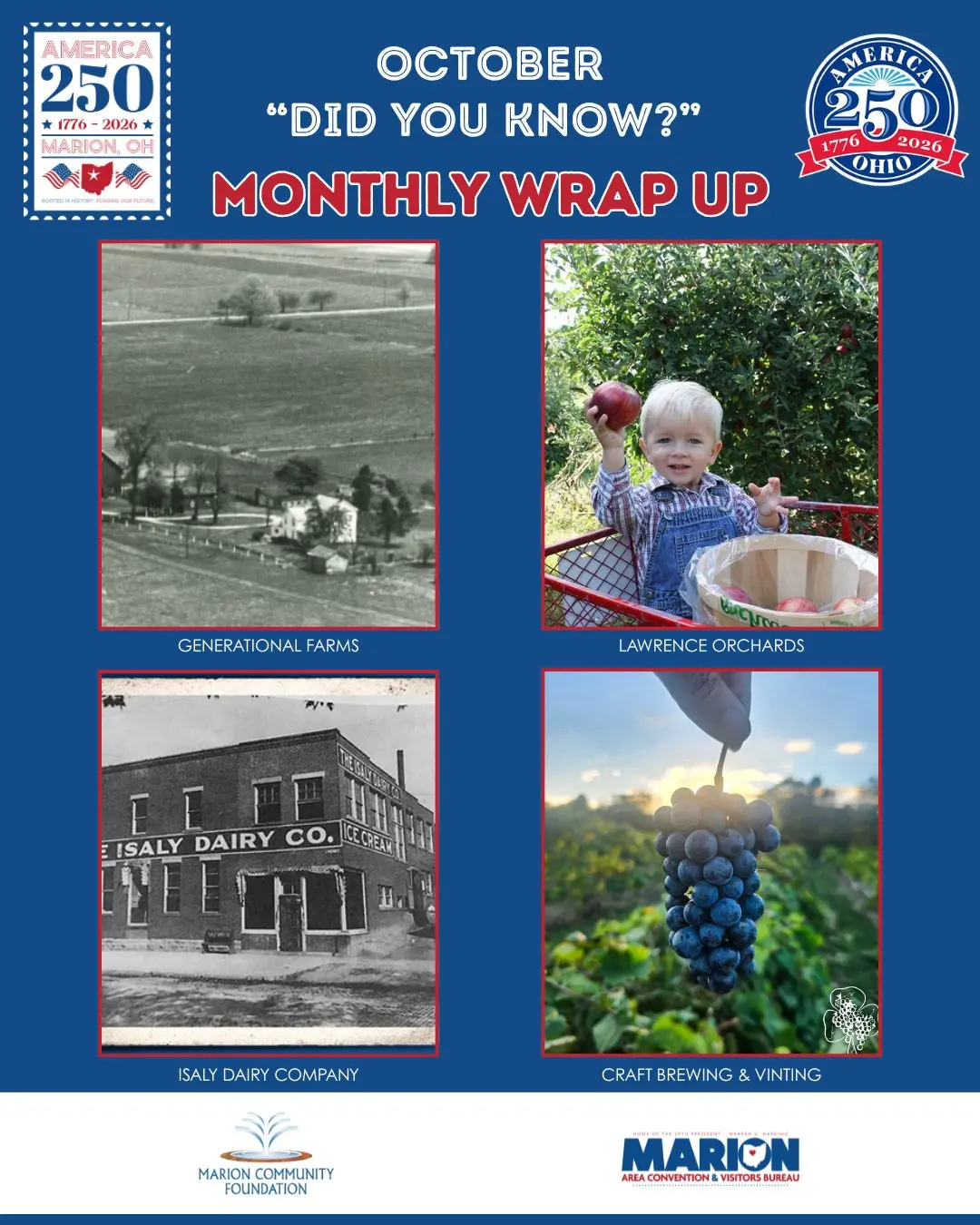
Marion County’s agricultural story reaches back to its earliest days. Today, the Ohio Department of Agriculture recognizes 32 Marion County farms as Historic Family Farms, an honor reserved for farms that have remained in the same family for at least 100 consecutive years while continuing to operate.
Some have been here for nearly as long as Marion County itself.
The county’s oldest registered Historic Family Farm, Irey Brothers, LLC, near Caledonia, was established in 1824. The Oris family farm followed in 1828, while Triple L Farm LLC, established in 1922, represents one of the county’s newest centennial farms.
These farms tell a story that is bigger than crops and acreage. They represent generations of stewardship and a willingness to adapt as farming itself has changed.
The equipment is different. The crops may change. Technology continues to advance. But the values remain remarkably familiar: hard work, perseverance, and caring for the land so it can be entrusted to the next generation.
That spirit of generational stewardship is one of Marion County’s greatest agricultural treasures.
Growing More Than Apples
Few places capture the connection between agriculture, family, and tradition quite like Lawrence Orchards.
The story began in 1923, when Dale Lawrence planted the first apple trees. Four generations later, the orchard has grown into a beloved fall destination where apples, pumpkins, cider, farm animals, seasonal activities, and family memories come together.
The Lawrence family has never been afraid to let the orchard evolve. Fruit production expanded. A farm market was added. Pick-your-own apples, pumpkins, award-winning cider, and seasonal attractions became part of the experience.
And then there was Applefest.
In 1985, George and Vickie Lawrence hosted a simple gathering as a thank-you to family and friends. About 300 people attended that first celebration. Today, thousands make their way to the orchard each fall.
The scale may have changed, but the heart of the tradition has not.
For more than a century, Lawrence Orchards has demonstrated that the sweetest harvest isn’t necessarily what comes off the tree. Sometimes, it is the tradition of families returning year after year to make memories together.
From Marion to the Nation
Agriculture has also created stories that reach far beyond Marion County.
Long before the Klondike Bar became famous nationwide, the Isaly Dairy Company was producing it as a regional favorite. Marion became part of that story in 1914 when Isaly’s established local operations and quickly expanded its reach throughout the region.
A new dairy plant opened on East Center Street in 1947, where employees handcrafted Klondike bars by cutting frozen slabs of ice cream, hooking each piece by hand, and dipping it in chocolate.
The plant’s opening was an event in itself. Crowds gathered to celebrate, including thousands who came for the chance to enjoy one of Isaly’s famous treats. The company even gave away 24,000 “Skyscraper” ice cream cones that day.
Eventually, Isaly’s shifted away from dairy production and toward restaurants. Marion’s Isaly Shoppe remained a gathering place for generations until it closed in 1996.
The Klondike Bar may have become a national brand, but its Marion story remains a delicious piece of local history—a reminder that some of the most familiar American traditions have roots right here at home.
What Grows Next
Marion County’s food and farming story doesn’t end with the traditions of the past.
It continues to grow.
Today, locally owned vinting and brewing businesses are adding new chapters to the community’s agricultural and culinary identity.
At Shamrock Vineyard, that story began in 1971, when Dr. Thomas N. Quilter and his wife, Mary, planted grapevines near their farmhouse to discover what might grow in Central Ohio. Their experiment succeeded. Shamrock is credited with the first successful wine-grape planting in Central Ohio, and the family tradition continues today.
In downtown Marion, Marion Brewing Company has brought a different kind of agricultural tradition to life. Since opening in 2019, the brewery has grown from a one-barrel operation into a downtown gathering place producing beers and seltzers enjoyed both locally and throughout Ohio.
And at Blend of Seven Winery, a family hobby that began after a 2008 winery visit eventually became an award-winning business. Today, its downtown location offers Ohio-influenced wines and a place for people to gather, taste, create, and enjoy live entertainment together.
Three businesses. Three different stories. One common thread: taking what grows from the land—or the inspiration it provides—and turning it into something that brings people together.
A Story Still Being Written
Perhaps that is what makes Marion County’s agricultural heritage so compelling.
It isn’t simply a story about the past.
It is a story that is still growing.
Century farms continue traditions that began generations ago. Orchards create new memories for families who return each fall. Businesses like Isaly’s once connected Marion to a national food story. Today’s vineyards, breweries, and wineries are creating new local traditions of their own.
From the farm field to the family table, from historic barns to downtown gathering places, agriculture continues to influence how Marion County works, celebrates, gathers, and grows.
This October, as we explore Marion Grows: Food & Farms, we’re celebrating more than what comes from the soil.
We’re celebrating the people who tend it.
The families who preserve it.
The entrepreneurs who build upon it.
And the generations who continue to find new ways to make something grow.
Because in Marion County, some of our best traditions aren’t just preserved—they’re planted, nurtured, and passed on.